- November 19, 2026
- by Mani SEO
- Uncategorized
- 0 Comments
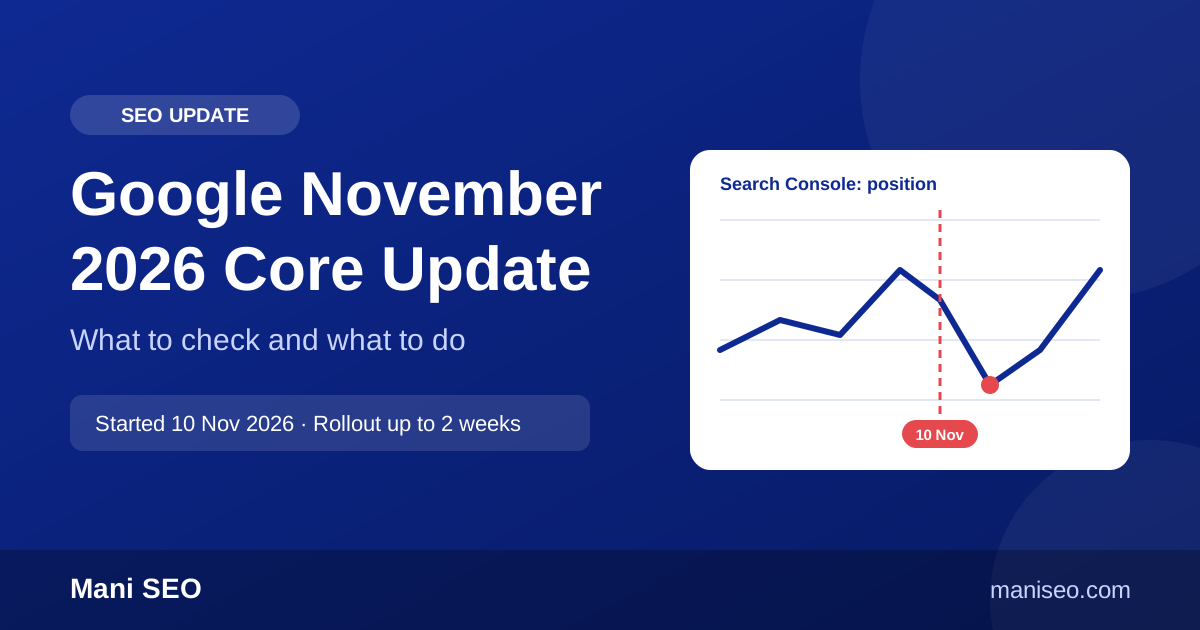
Google started rolling out the November 2026 core update on 10 November 2026. If your rankings or organic traffic have moved in the past few days, this guide explains what the update is, how to check whether it affected you, and which mistakes to avoid.
What is the November 2026 core update?
According to the Google Search Status Dashboard, the update began on 10 November 2026 at 10:06 AM US Pacific time, which was late evening in India the same day. It applies globally and to all languages, and Google says the rollout can take up to two weeks to complete.
A core update is a broad change to Google’s ranking systems, which Google says happens several times a year. Google describes these changes as aimed at surfacing helpful and reliable results overall. They don’t target specific sites or individual pages.
Google compares it to updating a list of favorite restaurants. New places appear, and some are reassessed. A restaurant that drops down the list isn’t necessarily bad. There are just other options that now fit better. The same applies to your pages: losing a position doesn’t automatically mean something is wrong with your site.
Don’t panic during the rollout
Rankings can fluctuate while an update is still rolling out. Google’s guidance is to confirm the update has finished before analyzing anything, so check the Search Status Dashboard for the end date. Most sites don’t need to worry about core updates and may not even notice one.
How to check your traffic in Google Search Console
Follow these steps once the rollout is complete:
- Note the start and end dates of the update on the Search Status Dashboard.
- Wait at least a full week after the update finishes before analyzing data.
- Compare the right periods. Compare the week after completion with the week before the update began (before 10 November).
- Review your top pages and queries. See how each one ranked before and after.
- Analyze search types separately. Look at Web, Images, Video and News on their own, because a drop may be limited to one of them.
Is your drop small or large?
- Small drop (for example, position 2 to 4): No drastic action is needed. Google specifically advises against changing content that is already performing well.
- Large, sustained drop (for example, position 4 to 29): This is worth a deeper assessment of your whole site, not just single pages.
How to assess a large drop
Start with Google’s helpful, reliable, people-first content self-assessment questions:
- Be objective about your whole site. Ask people unaffiliated with your business to review it using Google’s questions.
- Study the most affected pages. Ask whether other pages on the web now answer the searcher’s question better than yours.
- Check for signs of trust and expertise. Does each page show who wrote it, their experience and their evidence? Are claims backed by sources?
Mistakes to avoid after a core update
- Quick fixes. Don’t remove a page element just because you heard it is “bad for SEO”. Make changes that genuinely help users and last.
- Deleting content in a hurry. Google calls deletion a last resort. If you are thinking of removing whole sections, that may mean they were written for search engines first and people second, and removing the unhelpful ones can help your better content.
- Rewriting everything at once. Improve content in meaningful ways, such as better structure, clearer explanations, original examples and accurate, up-to-date information.
- Expecting instant results. Some changes show an effect in days, but it can take several months for Google’s systems to confirm that your site is consistently helpful. If nothing changes after a few months, the next core update may be when you see movement. Google also says there is no guarantee that changes will produce a noticeable impact.
What to improve while you wait
Good long-term work doesn’t depend on any one update:
- Add first-hand experience: real case studies, original data and screenshots.
- Show who is behind the content, with author bios and verifiable credentials.
- Keep pages accurate and current, and remove outdated claims.
- Make sure your site is fast, mobile-friendly and easy to navigate.
- Earn genuine mentions and reviews rather than chasing shortcuts.
Frequently asked questions
When did the Google November 2026 core update start?
It began on 10 November 2026 and can take up to two weeks to roll out.
Should I change my website right now?
No. Wait until the rollout finishes, then compare a full week of data with the week before the update began.
How long does recovery take?
It varies. Some improvements show in days, while others take months. There are no guarantees.
Does a ranking drop mean my site was penalized?
Not necessarily. Core updates are broad reassessments, not penalties aimed at individual sites.
Need help analyzing your traffic?
If your organic traffic changed after this update and you’d like a second opinion, Mani SEO can review your Search Console data, identify the most affected pages and suggest practical, people-first improvements. Book a free consultation.